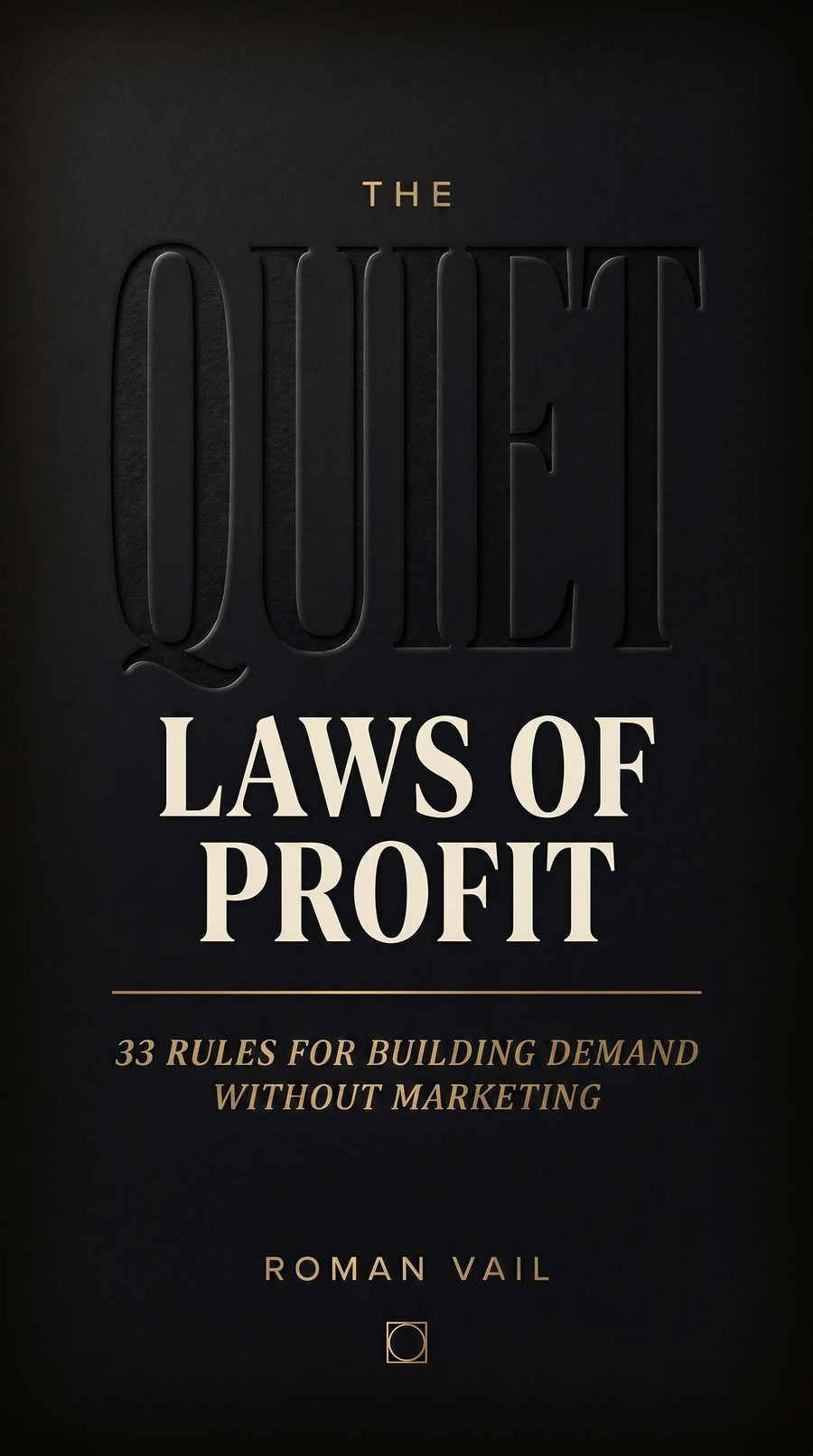
TheQuietLaws of Profit
33 Rules for Building Demand Without Marketing
The market never rewards louder.
It rewards clearer.
Kindle · Paperback · Free on Kindle Unlimited
Two decades of operator psychology.
From the merchants of seventeenth-century Amsterdam to the operators of modern Silicon Valley, the same psychological patterns repeat.
“Availability is the assassin of want.”
“The brain reads the line before it reads the menu.”
AAdoctrinedoctrineforforoperatorsoperatorswhowhorefuserefusetotocompetecompeteononvolume.volume.
The loud marketing religion preaches the same instructions to every operator: post every day, sell to everyone, be everywhere, never run out. The richest operators of the last hundred years did the opposite.
They sold less. They withdrew. They engineered scarcity. They let the crowd do the talking. They built businesses that compounded for decades while their louder competitors burned out.
- 33 psychological laws — each tied to a real operator
- 200+ case studies drawn from documented history
- Applicable inside your business by Tuesday
- No theory without a case. No case without a law.
“The customer does not pay for the result. The customer pays for the visible evidence that the result required work.”
This book documents what they did, in plain language, across 33 specific laws — each one tied to a real operator, a real case, a real outcome.
From the merchants of seventeenth-century Amsterdam to the operators of modern Silicon Valley, the same psychological patterns repeat. The book shows you which ones. And how to apply them in your own business by Tuesday.
The Law of Visible Scarcity
“Availability is the assassin of want.”
“Nothing is more useful than water; but it will purchase scarce any thing. A diamond, on the contrary, has scarce any value in use; but a very great quantity of other goods may frequently be had in exchange for it.”
— Adam Smith, The Wealth of Nations, 1776
What is everywhere is worth nothing. The brain was built, by millions of years of evolution, to value what is rare and ignore what is common — and the wealthiest operators of the last hundred years have built their fortunes on this single fact.
They have engineered rarity on purpose. The Loud Marketing Religion preaches the opposite: be everywhere, post every day, sell to everyone, never run out. The shop on the block that wins is the one that, deliberately, sometimes runs out.
Why quiet works.
Everything the loudest operators get wrong, laid beside what actually works.
“Arriving early is the cheapest form of preparation. The wealthy know it. The poor mistake it for paranoia.”
All 33 laws.
Each backed by documented case studies. Each applicable by Tuesday.
33 laws.
Each one a sentence.
Selected excerpts from the manuscript. The full doctrine is inside.
“What is everywhere is worth nothing. The mind values what is rare and ignores what is common — and the operator who understands this engineers scarcity on purpose.”
“The customer does not pay for the result. The customer pays for the visible evidence that the result required work.”
“The wealthy operator is not the operator who has read this book most carefully. The wealthy operator is the operator who has applied this book longest.”
“What is everywhere is worth nothing. The mind values what is rare and ignores what is common — and the operator who understands this engineers scarcity on purpose.”
“The customer does not pay for the result. The customer pays for the visible evidence that the result required work.”
“The wealthy operator is not the operator who has read this book most carefully. The wealthy operator is the operator who has applied this book longest.”
“Nothing has inherent value. Everything is worth what the frame around it suggests it is worth. Change the frame. Change the price.”
“The first number spoken in any negotiation becomes the floor of all future reference. Place your anchor before they place theirs.”
“A price without a story is a number. A number invites negotiation. A story invites desire. Price your work with a story attached.”
“Nothing has inherent value. Everything is worth what the frame around it suggests it is worth. Change the frame. Change the price.”
“The first number spoken in any negotiation becomes the floor of all future reference. Place your anchor before they place theirs.”
“A price without a story is a number. A number invites negotiation. A story invites desire. Price your work with a story attached.”
“The mind cannot rest when a question has no answer. The merchant who opens the loop first commands the customer's return.”
“A buyer believes half of what you say. A buyer believes everything a third party says about you. Engineer witnesses.”
“Customers remember two moments: the peak of their experience and how it ended. Manage these two moments. The middle will take care of itself.”
“The mind cannot rest when a question has no answer. The merchant who opens the loop first commands the customer's return.”
“A buyer believes half of what you say. A buyer believes everything a third party says about you. Engineer witnesses.”
“Customers remember two moments: the peak of their experience and how it ended. Manage these two moments. The middle will take care of itself.”
Read the opening law free, then decide. Look inside on Amazon →
He writes from outside the noise.
Roman Vail writes about the psychology of profit — how money moves, how demand is built, how pricing power is held, and why the patient operator quietly wins in markets that reward noise over substance.
He has spent two decades working alongside businesses of every shape and scale — from founders launching their first venture to executives running established enterprises across continents. The doctrine in his work emerged from watching the same psychological patterns repeat across all of them, regardless of industry or size.
He writes from outside the conventional business-media ecosystem. He does not give podcast interviews. He does not maintain a presence on the standard social platforms. He publishes through this website, and through a small private list of readers who have asked, directly, to be notified when new work arrives.
Roman Vail is currently at work on his second book, The Quiet Laws of Failure — 33 Ways Operators Destroy What They Build.
The Quiet Operating
System Scorecard.
All 33 laws on a single printable page.
Three columns: Studied. Applied. Working. Mark each row as you study the law, apply the move, and watch it begin to compound in your business.
One quiet notification.
Nothing more.
When Roman Vail’s next work is ready, you will be the first to know. No newsletter. No noise. No frequency obligation.
One email when the next book publishes. Unsubscribe any time.